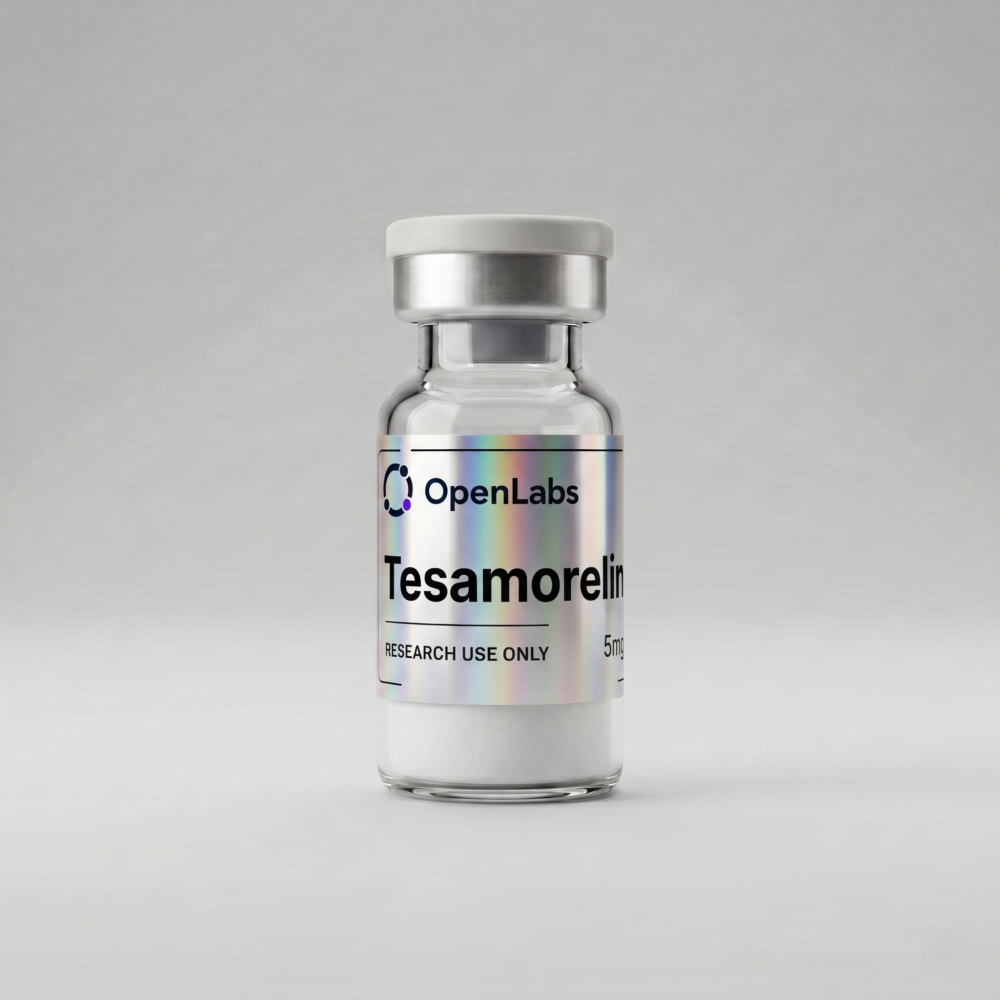
Tesamorelin 5 mg
SKU OL-TESA-5
Description
Tesamorelin
Synthetic N-Terminally Modified Growth Hormone-Releasing Factor Analog
Tesamorelin is a synthetic 44-amino-acid analog of human growth hormone-releasing factor, also known as growth hormone-releasing hormone. It retains the complete amino-acid sequence of human GRF(1-44)-NH2 and incorporates a trans-3-hexenoyl group attached to the N-terminal tyrosine residue. This modification was developed to improve peptide stability while retaining agonist activity at the growth hormone-releasing hormone receptor.
OpenLabs supplies Tesamorelin exclusively as a biochemical research material for controlled laboratory applications. It may be used in studies involving GHRH-receptor pharmacology, pituitary signaling, growth-hormone secretion, the GH–IGF-1 axis, adipose-tissue biology, lipid metabolism, and peptide-stability research.
In experimental systems, Tesamorelin binds to and activates the human growth hormone-releasing hormone receptor, or GHRHR. This class B G-protein-coupled receptor is principally associated with Gs-mediated adenylyl-cyclase activation, increased intracellular cyclic AMP, and downstream signaling that promotes the synthesis and secretion of endogenous growth hormone from anterior-pituitary somatotroph cells. Increased growth-hormone signaling can subsequently elevate circulating insulin-like growth factor 1 and IGF-binding protein 3.
Technical Information
- Product name:
- Tesamorelin
- Alternative name:
- TH9507; TH-9507; (3E)-hex-3-enoylsomatoliberin; trans-3-hexenoyl-GRF(1-44)-NH2
- Chemical class:
- Synthetic peptide hormone analog; N-terminally acylated human growth hormone-releasing factor analog
- Primary research target:
- Growth hormone-releasing hormone receptor (GHRHR; growth hormone-releasing factor receptor)
- Peptide length:
- 44 amino-acid residues, with an N-terminal trans-3-hexenoyl modification and an amidated C-terminus
- Molecular formula:
- C221H366N72O67S (tesamorelin free peptide)
- Molecular weight:
- 5135.78 g/mol average molecular mass; the FDA prescribing information reports 5135.9 Da as the free-base equivalent
- CAS number:
- 218949-48-5 for tesamorelin; 901758-09-6 for tesamorelin acetate
- PubChem CID:
- 16137828
Amino-Acid Sequence
trans-3-hexenoyl-Tyr-Ala-Asp-Ala-Ile-Phe-Thr-Asn-Ser-Tyr-Arg-Lys-Val-Leu-Gly-Gln-Leu-Ser-Ala-Arg-Lys-Leu-Leu-Gln-Asp-Ile-Met-Ser-Arg-Gln-Gln-Gly-Glu-Ser-Asn-Gln-Glu-Arg-Gly-Ala-Arg-Ala-Arg-Leu-NH2
One-letter notation: trans-3-hexenoyl-YADAIFTNSYRKVLGQLSARKLLQDIMSRQQGESNQERGARARL-NH2
Scientific Background
Endogenous human growth hormone-releasing hormone is synthesized in the hypothalamus and regulates pulsatile growth-hormone secretion through GHRHR expressed by anterior-pituitary somatotroph cells. Tesamorelin contains the complete biologically active 44-residue sequence of human GRF with an N-terminal trans-3-hexenoyl modification. Native GRF is susceptible to rapid enzymatic inactivation, including cleavage near its N-terminus. The lipid-derived N-terminal modification in Tesamorelin increases resistance to proteolytic degradation while preserving GHRHR-agonist activity.
Experimental and controlled clinical studies of regulated pharmaceutical Tesamorelin formulations have demonstrated stimulation of endogenous growth-hormone secretion, increased IGF-1 and IGFBP-3 concentrations, and changes in adipose-tissue distribution and lipid metabolism. Studies in adults with HIV-associated abdominal fat accumulation reported reductions in visceral adipose tissue without a comparable reduction in subcutaneous adipose tissue. Separate investigations in participants with HIV and hepatic steatosis examined changes in liver-fat content, inflammatory markers, and fibrosis-related measurements. These observations remain specific to the studied formulations, populations, and protocols and do not establish equivalent activity for uncharacterized research material. The U.S. approval of pharmaceutical Tesamorelin applies only to its regulated prescription formulation and does not apply to this research-use product.
Potential Research Applications
- Characterization of GHRHR binding, receptor activation, and downstream cyclic-AMP-dependent signaling
- Investigation of pituitary somatotroph activity, pulsatile growth-hormone secretion, and GH–IGF-1-axis regulation
- Evaluation of N-terminal peptide acylation, plasma stability, proteolytic resistance, and structure–activity relationships
- Experimental studies of adipocyte metabolism, lipolytic signaling, visceral adipose tissue, and regional fat distribution
- Investigation of hepatic lipid metabolism, ectopic lipid accumulation, metabolic biomarkers, and GH-axis-associated liver signaling
Product Specifications
- Supplied form:
- Lyophilized peptide powder; counterion and peptide content are reported on the lot-specific Certificate of Analysis
- Nominal quantity:
- As stated on the vial label and lot-specific Certificate of Analysis
- Purity:
- Lot-specific; reported on the Certificate of Analysis
- Identity verification:
- Analytical methods and identity results are reported on the lot-specific Certificate of Analysis
- Storage conditions:
- Store unopened lyophilized material frozen, dry, tightly sealed, and protected from light. Minimize repeated temperature cycling and follow the lot-specific Certificate of Analysis as the controlling storage instruction.
- Certificate of Analysis:
- Available for each lot
Research-Use Restriction
FOR LABORATORY RESEARCH USE ONLY. NOT FOR HUMAN USE.
This material is not intended for human consumption, clinical administration, medical treatment, diagnostic use, cosmetic use, food use, household use, or pharmaceutical compounding.
It is not intended to diagnose, treat, cure, mitigate, or prevent any disease or medical condition. This product must be handled only by qualified personnel using appropriate laboratory procedures and protective equipment.
- COA available on select batches
- Insulated, tracked cold-chain shipping
- Encrypted checkout