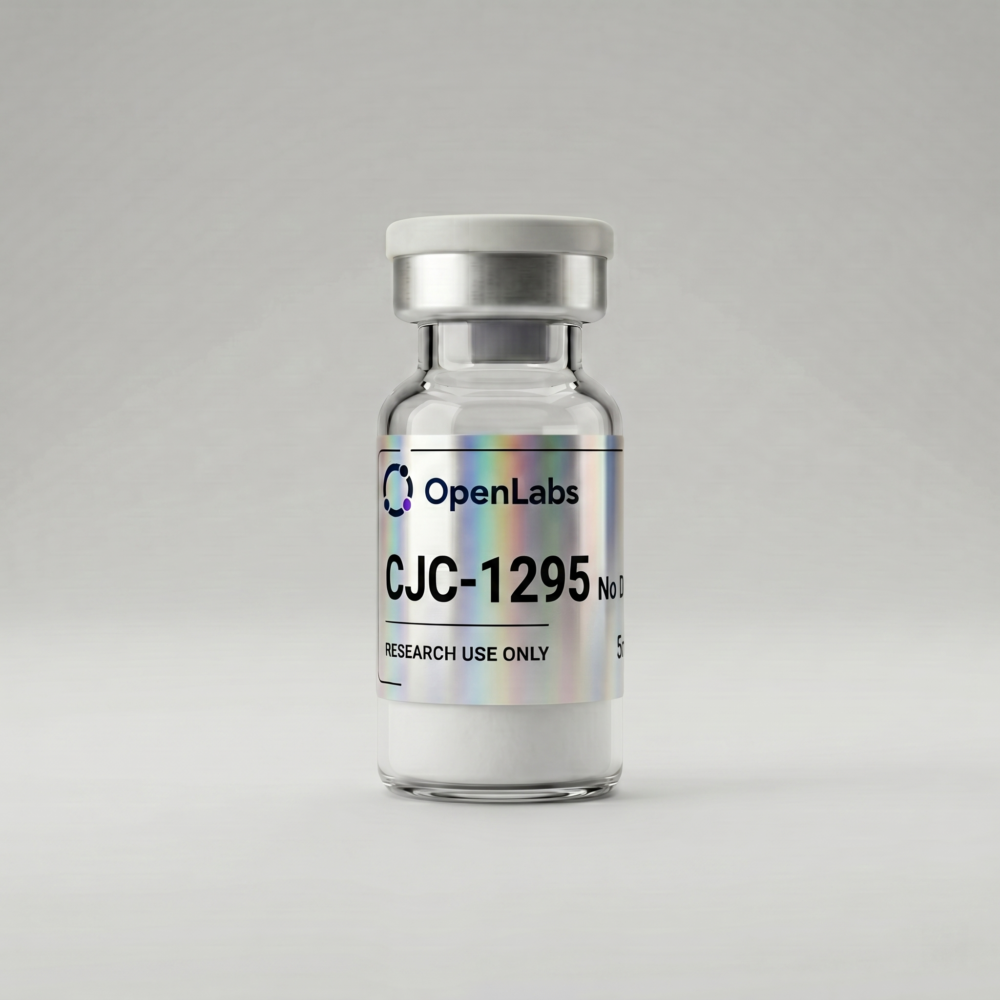
CJC-1295 (No DAC) 5 mg
SKU
Description
CJC-1295 (No DAC)
Tetrasubstituted Growth Hormone-Releasing Hormone Fragment Analog
CJC-1295 (No DAC) is a synthetic, C-terminally amidated 29-amino-acid analog of the biologically active N-terminal region of human growth hormone-releasing hormone. It is more precisely known as Modified GRF(1-29), or tetrasubstituted GRF(1-29), and contains four substitutions relative to native human GRF(1-29): D-alanine at position 2, glutamine at position 8, alanine at position 15, and leucine at position 27.
OpenLabs supplies CJC-1295 (No DAC) exclusively as a biochemical research material for controlled laboratory applications. It may be used in studies involving growth hormone-releasing hormone receptor pharmacology, pituitary signaling, growth-hormone secretion, peptide degradation, structure-activity relationships, and regulation of the experimental GH–IGF-1 axis.
In experimental systems, CJC-1295 (No DAC) acts as an agonist of the growth hormone-releasing hormone receptor, or GHRHR. GHRHR is a class B G-protein-coupled receptor expressed prominently by anterior-pituitary somatotroph cells. Receptor activation primarily stimulates Gs-dependent adenylyl cyclase activity, increases intracellular cyclic AMP, and engages protein kinase A and calcium-associated signaling involved in growth-hormone synthesis and secretion.
Technical Information
- Product name:
- CJC-1295 (No DAC)
- Alternative name:
- Modified GRF(1-29); Mod GRF(1-29); tetrasubstituted GRF(1-29); [D-Ala2, Gln8, Ala15, Leu27]-GRF(1-29)-NH2
- Chemical class:
- Synthetic growth hormone-releasing hormone fragment analog; C-terminally amidated peptide hormone analog
- Primary research target:
- Growth hormone-releasing hormone receptor (GHRHR; growth hormone-releasing factor receptor)
- Peptide length:
- 29 amino-acid residues
- Molecular formula:
- C152H252N44O42 (free peptide)
- Molecular weight:
- 3367.90 g/mol (average molecular mass, free peptide)
- CAS number:
- 863288-34-0, commonly assigned to the no-DAC peptide
- PubChem CID:
- 91976842
Amino-Acid Sequence
H-Tyr-D-Ala-Asp-Ala-Ile-Phe-Thr-Gln-Ser-Tyr-Arg-Lys-Val-Leu-Ala-Gln-Leu-Ser-Ala-Arg-Lys-Leu-Leu-Gln-Asp-Ile-Leu-Ser-Arg-NH2
Modified one-letter notation: Y-(D-A)-DAIFTQSYRKVALQLSARKLLQDILSR-NH2. The residue at position 2 is D-alanine rather than the naturally occurring L-alanine stereoisomer.
Scientific Background
Human growth hormone-releasing hormone is a hypothalamic peptide that regulates the synthesis and pulsatile secretion of growth hormone from anterior-pituitary somatotroph cells. Its first 29 residues contain the principal receptor-activating region and form the basis of GRF(1-29) analogs. Native GRF(1-29), also known as sermorelin, is rapidly degraded in biological systems, particularly through N-terminal cleavage that produces receptor-inactive metabolites.
Modified GRF(1-29) contains four residue substitutions relative to native human GRF(1-29). The D-Ala2 substitution increases resistance to enzymatic cleavage near the N-terminus and has been shown experimentally to reduce metabolic clearance compared with unmodified GRF(1-29). The additional Gln8, Ala15, and Leu27 substitutions alter chemical or enzymatic stability while preserving the receptor-active GHRH sequence. Replacement of methionine at position 27 with leucine also removes an oxidation-sensitive sulfur-containing residue.
The term “CJC-1295 (No DAC)” is widely used commercially but requires an important structural qualification. The compound originally designated CJC-1295 contained the same tetrasubstituted GRF core plus an additional C-terminal lysine bearing a reactive maleimidopropionyl group. That Drug Affinity Complex, or DAC, forms a covalent bond with circulating albumin and substantially prolongs systemic exposure.
CJC-1295 (No DAC), as described here, lacks the C-terminal maleimidopropionyl-lysine extension. It therefore does not possess the intended covalent albumin-binding mechanism of authentic DAC-containing CJC-1295. Pharmacokinetic and human-study findings obtained with albumin-binding CJC-1295 should not be directly attributed to Modified GRF(1-29), because the two compounds differ materially in structure, albumin association, and duration of exposure.
Following GHRHR activation, experimentally released growth hormone can engage growth hormone receptors in peripheral tissues and influence hepatic and extrahepatic production of insulin-like growth factor 1. Accordingly, Modified GRF(1-29) may be used to investigate both immediate GHRHR signaling and secondary GH–IGF-1-axis responses. Observed activity depends on the species, model system, receptor expression, endogenous somatostatin tone, exposure duration, and analytical protocol.
Potential Research Applications
- Characterization of GHRHR binding, receptor activation, cyclic-AMP production, protein kinase A signaling, and calcium-associated responses
- Investigation of anterior-pituitary somatotroph function and experimentally induced growth-hormone secretion
- Structure-activity studies comparing native GRF(1-29), sermorelin, Modified GRF(1-29), and other GHRH analogs
- Evaluation of N-terminal proteolysis, DPP-IV-associated degradation, peptide stability, metabolic clearance, and oxidation-sensitive residues
- Comparison of short-exposure GHRHR agonists with DAC-containing, albumin-binding GHRH analogs in experimental GH–IGF-1-axis models
Product Specifications
- Supplied form:
- Lyophilized peptide powder; counterion and peptide content are reported on the lot-specific Certificate of Analysis
- Nominal quantity:
- As stated on the vial label and lot-specific Certificate of Analysis
- Purity:
- Lot-specific; reported on the Certificate of Analysis
- Identity verification:
- Lot-specific analytical verification as reported on the Certificate of Analysis
- Storage conditions:
- Store unopened lyophilized material frozen at or below −20°C, dry, tightly sealed, and protected from light and moisture. Minimize repeated temperature cycling. Prepared laboratory solutions should be handled according to validated stability procedures and the lot-specific Certificate of Analysis, which serves as the controlling storage instruction.
- Certificate of Analysis:
- Available for each lot
Research-Use Restriction
FOR LABORATORY RESEARCH USE ONLY. NOT FOR HUMAN USE.
This material is not intended for human consumption, clinical administration, medical treatment, diagnostic use, cosmetic use, food use, household use, or pharmaceutical compounding.
It is not intended to diagnose, treat, cure, mitigate, or prevent any disease or medical condition. This product must be handled only by qualified personnel using appropriate laboratory procedures and protective equipment.
- COA available on select batches
- Insulated, tracked cold-chain shipping
- Encrypted checkout