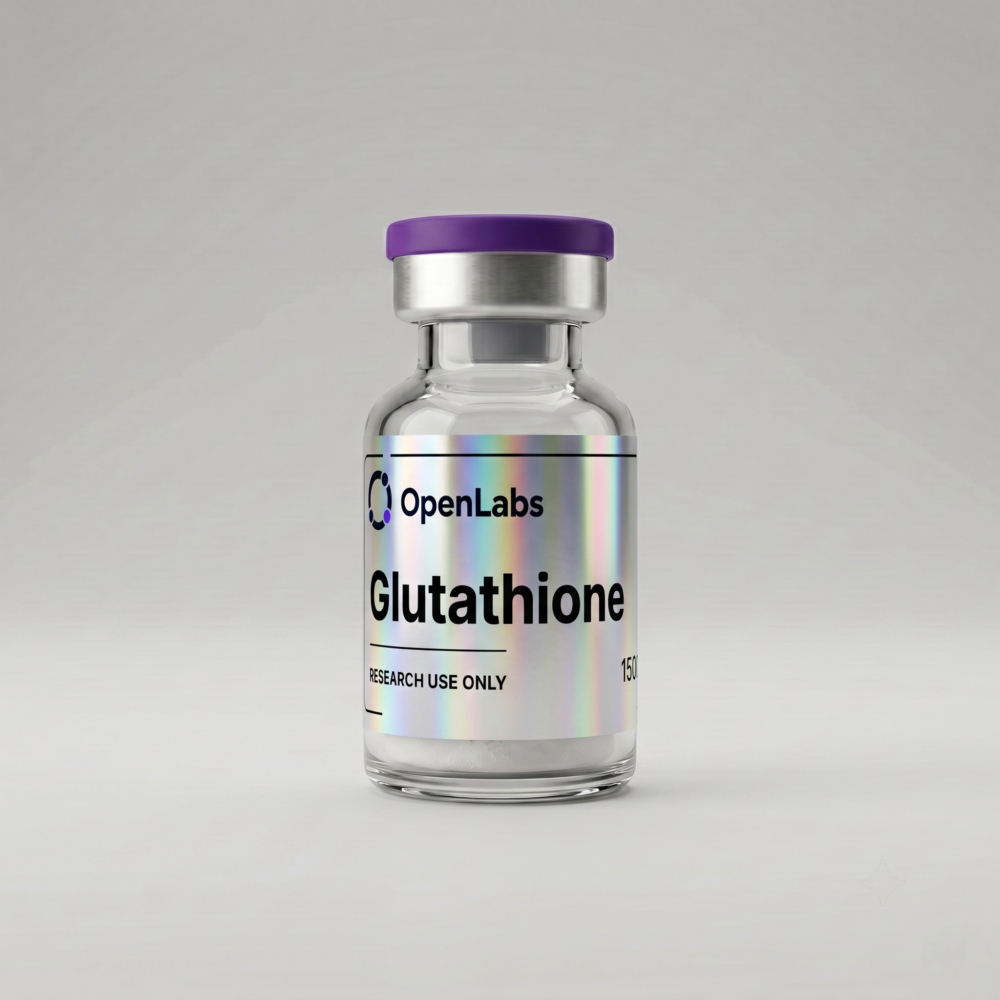
Glutathione 1500 mg
SKU OL-GT-1500
Description
Glutathione
Endogenous Thiol-Containing γ-Glutamyl Tripeptide and Cellular Redox Cofactor
Glutathione is an endogenous, sulfur-containing tripeptide composed of L-glutamate, L-cysteine, and glycine. Unlike a conventional tripeptide, its glutamate residue is joined to cysteine through the glutamate side-chain γ-carboxyl group rather than through the usual α-carboxyl group. This entry describes reduced L-glutathione, commonly abbreviated GSH, which contains a free cysteine thiol group and is chemically distinct from oxidized glutathione disulfide, or GSSG.
OpenLabs supplies Glutathione exclusively as a biochemical research material for controlled laboratory applications. It may be used in studies involving cellular redox homeostasis, oxidative-stress responses, glutathione-dependent enzyme systems, electrophile conjugation, protein-thiol regulation, lipid peroxidation, and ferroptosis-associated pathways.
In experimental systems, reduced glutathione participates in thiol-disulfide exchange and serves as a reducing substrate for multiple enzyme families. Glutathione peroxidases use GSH-derived reducing equivalents to reduce hydrogen peroxide or organic hydroperoxides, generating glutathione disulfide. Glutathione reductase uses NADPH to regenerate GSH from GSSG, while glutathione S-transferases catalyze the conjugation of GSH to many electrophilic compounds. Glutathione also participates in reversible protein S-glutathionylation and glutaredoxin-dependent regulation of protein thiols.
Technical Information
- Product name:
- Glutathione
- Alternative name:
- Reduced glutathione; L-glutathione; GSH; γ-L-glutamyl-L-cysteinylglycine; L-γ-glutamyl-L-cysteinylglycine
- Chemical class:
- Endogenous thiol-containing tripeptide; γ-glutamyl peptide; low-molecular-weight cellular redox cofactor
- Primary research target:
- Cellular glutathione redox and conjugation systems, including glutathione peroxidases, glutathione reductase, glutathione S-transferases, and glutaredoxins
- Peptide length:
- 3 amino-acid residues
- Molecular formula:
- C10H17N3O6S (reduced glutathione free acid)
- Molecular weight:
- 307.32 g/mol
- CAS number:
- 70-18-8
- PubChem CID:
- 124886
Amino-Acid Sequence
γ-L-Glu-L-Cys-Gly
Condensed notation: γ-ECG. The γ designation indicates that the peptide bond between glutamate and cysteine is formed through the glutamate side-chain carboxyl group rather than its conventional α-carboxyl group.
Scientific Background
Glutathione is a widely distributed intracellular, non-protein thiol that contributes to the control of cellular redox conditions. It is synthesized in two ATP-dependent reactions. Glutamate-cysteine ligase first combines glutamate and cysteine to produce γ-glutamylcysteine. Glutathione synthetase then adds glycine to form GSH. The first reaction is generally considered the rate-limiting step in de novo glutathione biosynthesis and is influenced by cysteine availability, feedback regulation, and cellular stress-response pathways.
Reduced glutathione and glutathione disulfide form an important cellular thiol-disulfide redox couple. During glutathione peroxidase-catalyzed reactions, two molecules of GSH provide reducing equivalents for the conversion of hydrogen peroxide to water or organic hydroperoxides to their corresponding alcohols. This process produces GSSG, which can be converted back to two molecules of GSH by NADPH-dependent glutathione reductase. Experimental measurements of GSH, GSSG, total glutathione, and the GSH-to-GSSG relationship are therefore commonly used when studying cellular redox status.
Glutathione also functions as a substrate for glutathione S-transferases, which catalyze its conjugation to electrophilic endogenous metabolites, xenobiotics, and products of oxidative damage. These conjugation reactions generally occur through the nucleophilic sulfur atom of the cysteine residue. Glutathione conjugates may subsequently undergo additional enzymatic processing as part of cellular transport and metabolic pathways.
Through reversible S-glutathionylation, glutathione can form mixed disulfides with susceptible cysteine residues in proteins. This modification can protect protein thiols from irreversible oxidation and can alter enzyme activity, protein interactions, localization, or signaling. Glutaredoxin enzymes participate in the formation and removal of these modifications, depending on the local biochemical environment.
GSH is also a reducing substrate for glutathione peroxidase 4, an enzyme that reduces phospholipid hydroperoxides within biological membranes. Depletion of cellular glutathione or disruption of GPX4 activity is therefore frequently investigated in studies of lipid peroxidation and ferroptosis. These pathways are experimentally complex, and the effect of added glutathione depends on cellular uptake, compartmentalization, extracellular metabolism, concentration, and model-specific conditions.
Potential Research Applications
- Measurement and manipulation of GSH, GSSG, total glutathione, and cellular redox-state indicators
- Glutathione peroxidase, glutathione reductase, glutathione S-transferase, and glutaredoxin enzyme assays
- Investigation of reactive oxygen species, peroxide metabolism, oxidative stress, and thiol-disulfide exchange
- Studies of electrophile conjugation, xenobiotic metabolism, protein S-glutathionylation, and cysteine-redox signaling
- Experimental analysis of GPX4 activity, phospholipid hydroperoxides, lipid peroxidation, and ferroptosis-associated pathways
Product Specifications
- Supplied form:
- Reduced L-glutathione powder; physical form and counterion status are reported on the lot-specific Certificate of Analysis
- Nominal quantity:
- As stated on the vial label and lot-specific Certificate of Analysis
- Purity:
- Lot-specific; reported on the Certificate of Analysis
- Identity verification:
- Analytical methods and identity results are reported on the lot-specific Certificate of Analysis
- Storage conditions:
- Store refrigerated at 2–8°C in a dry, tightly sealed container protected from light and moisture. Minimize unnecessary exposure to air and prepare aqueous solutions fresh when practical because reduced glutathione can oxidize in solution. Follow the lot-specific Certificate of Analysis as the controlling storage instruction.
- Certificate of Analysis:
- Available for each lot
Research-Use Restriction
FOR LABORATORY RESEARCH USE ONLY. NOT FOR HUMAN USE.
This material is not intended for human consumption, clinical administration, medical treatment, diagnostic use, cosmetic use, food use, household use, or pharmaceutical compounding.
It is not intended to diagnose, treat, cure, mitigate, or prevent any disease or medical condition. This product must be handled only by qualified personnel using appropriate laboratory procedures and protective equipment.
- COA available on select batches
- Insulated, tracked cold-chain shipping
- Encrypted checkout